
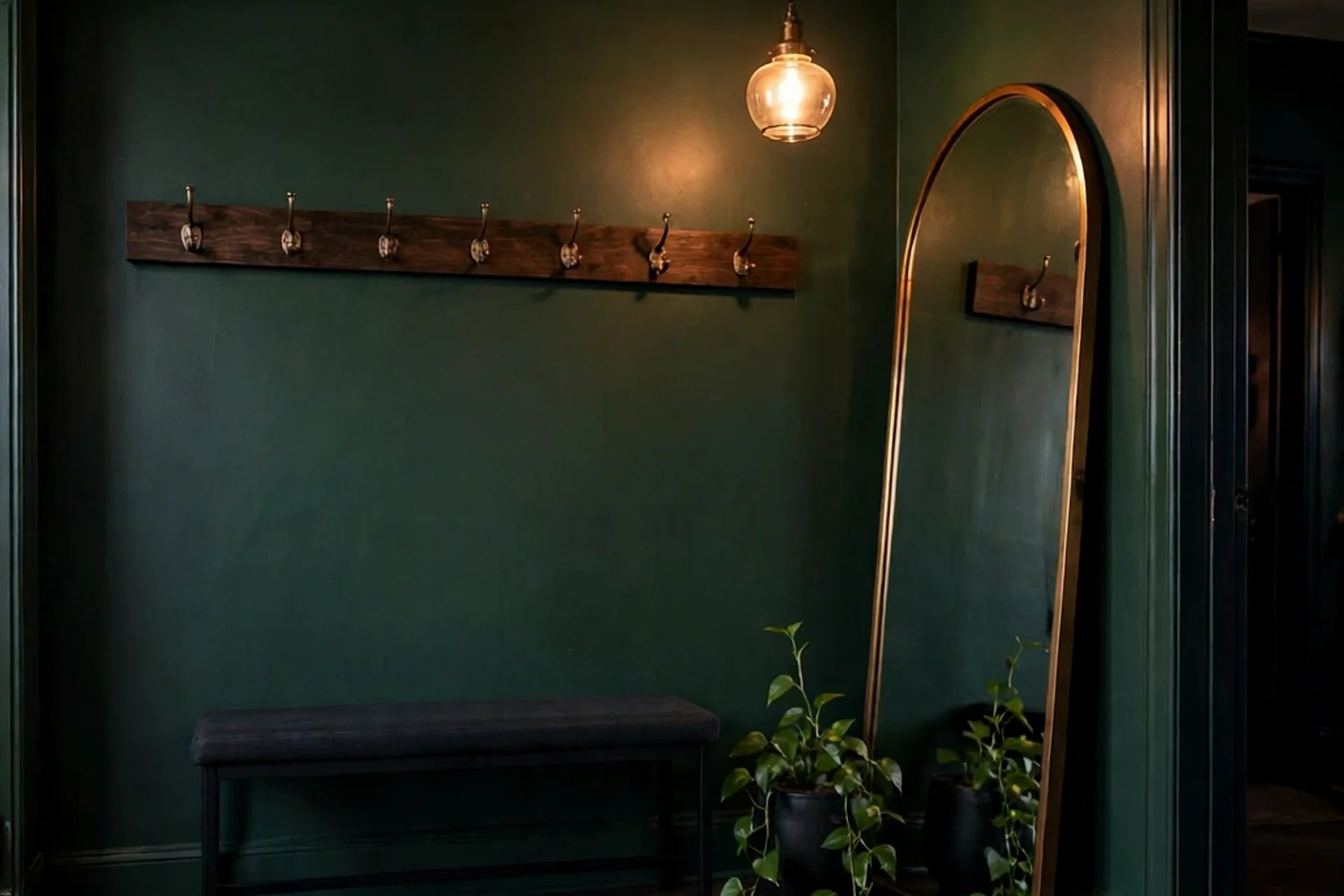
A dark entryway in a small apartment sounds like a mistake. Dark colours in a tiny space, with no window and barely three feet of floor — most advice says to keep it pale and bright. But a small dark entryway can be the most beautiful room in the home. When the colour is deep and the light is warm, the entry stops feeling like a narrow passage and starts feeling like a jewel box: intentional, moody, and welcoming in a way pale walls never manage.
This guide shows how to make a dark entryway work in a small apartment: the right dark colours, renter-friendly ways to get them on the wall, warm light that keeps the space welcoming, and storage that disappears into the dark instead of cluttering it.
1. Why dark works in a tiny entryway
Dark paint blurs the edges of a room. In a pale entryway, every corner, scuff and awkward angle is visible. In a dark one, the corners soften and the eye stops measuring the space. The room feels deeper instead of smaller, because the walls stop shouting about where they end. That is why restaurants and hotels paint their smallest lobbies dark: the colour makes a tight space feel deliberate.
A dark entryway also sets a mood for the whole home. You step out of a bright hallway into a warm, moody pocket, and then into your living room — the change makes the living room feel brighter by contrast. Think of the entry as a threshold, not a room. It only needs to do three things: welcome you home, hold your coat and keys, and look beautiful while it does them.
2. The palette: charcoal, forest green, and deep navy
The best dark colours for a small entry are the ones with warmth in them. Charcoal with a warm undertone, deep forest green, and dark navy all work, because they read as colours rather than as black. A flat, cold black can feel harsh and unfinished. A green or navy with depth feels like a choice.
Pick one dark colour and repeat it. The walls carry the colour, and everything else stays warm: natural wood, brass, cognac leather, cream. One dark wall colour plus one wood tone plus one metal is the whole formula. If you add a second dark colour, keep it close — forest green walls with a charcoal bench, for example — so the entry still reads as one calm space.
3. Dark walls without paint: renter-friendly options
If you rent, you may not be allowed to paint, and a dark colour feels like a big commitment even if you can. Removable wallpaper is the easiest way to go dark: one wall in a deep botanical or geometric print gives you the mood without touching the paint. Peel-and-stick panels come off cleanly when you move, so test one strip behind the door first.
If wallpaper feels like too much, fake the dark wall. A large dark art print, a tall dark mirror, or a fabric wall hanging in deep green can cover most of one wall. A dark wood peg rail along the wall reads as a dark band and gives you hooks at the same time. Even a dark curtain panel hung on a tension rod across one wall creates the same cocoon feeling — and it comes down in minutes.
4. Light that keeps a dark entry welcoming
A dark entryway lives or dies by its light. One warm bulb is the minimum: a small pendant, a wall sconce, or a lantern on the console, with a warm white bulb that makes the dark walls glow instead of looking flat. Cool white light is the enemy here — it turns deep green grey and makes charcoal look dusty.
Layer a second small light if you can: a battery-powered picture light over the art, a tiny lamp on the console, or a motion-sensor light inside a dark cupboard. A mirror opposite the light source doubles whatever light you have, so hang the mirror where it catches the pendant or the hallway light. The goal is a warm pool of light at face height, so the entry feels lit even though the walls are dark.
5. Storage that disappears into the dark
Dark storage is the secret weapon of a small dark entry. A slim bench in the same dark colour as the wall, dark hooks, and a dark basket for shoes all blend into the background instead of shouting for attention. The clutter disappears because the storage is the same colour as the room.
Keep it slim: a bench no deeper than 12 inches, three or four hooks at different heights, one basket for shoes and one small tray for keys and mail. A wall-mounted shelf in dark wood holds a plant and a candle without taking floor space. If the entry has a closet, paint or line the inside dark too, so opening the door does not break the mood with a flash of white.
6. The mirror trick: doubling light and space
Every dark entryway needs a mirror, and the bigger the better. A tall arched mirror or a round mirror in a brass frame bounces light around the room and gives you a last look before you leave. In a dark room the mirror does double duty: it reflects the warm light and it breaks up the dark wall so the space does not feel closed in.
Hang the mirror at eye level and keep the frame warm — brass, wood, or dark bronze. A black frame can disappear into a dark wall, which is fine if you want the mirror to look like a window. Lean a tall mirror against the wall if you cannot hang anything: it works just as well, and a leaning mirror makes a narrow entry feel taller. Keep the mirror clean — dust shows faster on glass in a dark room than anywhere else.
7. Finishing touches: runner, plant, and brass
The finishing touches are what make a dark entry feel finished rather than just dark. A runner in a deep pattern — a vintage-style rug in wine, navy and cream — warms the floor and guides the eye into the home. Choose a low-pile runner that the door can swing over, and keep it narrow enough to leave a strip of floor visible on each side.
One plant is enough: a trailing pothos on the shelf or a small snake plant in a brass pot. The green reads beautifully against a dark wall, and the brass pot picks up the warm light. Add one brass detail — the hooks, the mirror frame, the tray — and repeat it twice more so it looks intentional. A small dish for keys, a candle on the console, and the entry is done.
Dark entryway checklist
- Pick one warm dark colour: charcoal, forest green, or deep navy.
- Go dark on one wall — or fake it with removable wallpaper or large dark art.
- Use warm bulbs only — no cool white light in a dark entry.
- Add a mirror opposite the light to double the glow.
- Choose dark storage so clutter blends into the walls.
- Keep the bench slim: no deeper than 12 inches.
- Lay a deep-patterned runner the door can swing over.
- Add one plant and repeat one brass detail three times.
- Keep the floor clear: coats on hooks, shoes in one basket.
- Step back and check: warm, moody, and welcoming — not gloomy.