
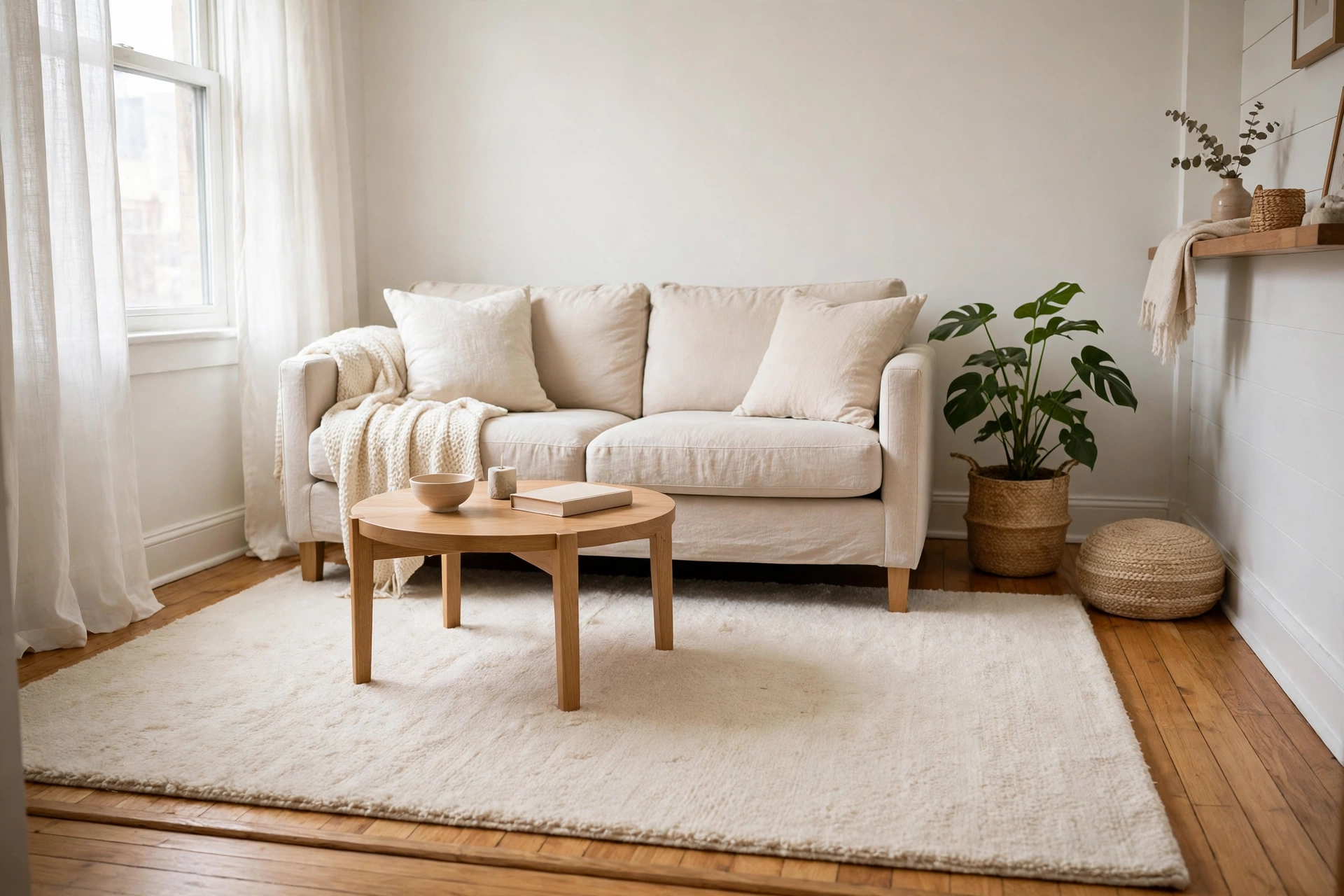
A rug is the fastest way to make a small living room feel finished, but only when it is placed well. The wrong size or the wrong spot can shrink the room instead of opening it up. These seven placements work for USA apartments and small homes, and every one of them is renter-friendly — no drilling, no damage, and nothing you cannot roll up and take with you when you move.
Put just the front legs on the rug
The classic small-room placement is to slide the rug under the front legs of the sofa and the chairs, with the back legs on the bare floor. This connects the seating into one group without needing a huge rug, and it works especially well in rooms where the sofa sits against a wall. Leave enough rug in front of the sofa for a coffee table to sit on it too, so the whole seating area reads as one finished zone.
Go big enough for all four legs
If the room allows it, a rug large enough for the whole sofa and chairs to sit on makes the room feel larger, not smaller. A common guide is to choose a rug that extends at least a few inches past each side of the sofa — a 5 by 7 rug suits a loveseat, while a standard three-seat sofa usually needs an 8 by 10. Measure the seating group first, then choose the rug, not the other way around.
Leave a border of floor showing
A rug that runs wall to wall makes a small room feel carpeted and cramped. Leave a border of bare floor around the rug — roughly the width of your hand, or a little more on larger floors — so the eye can see where the room ends. The border frames the rug like a picture frame and keeps the floor pattern, whether wood or tile, part of the look.
Use the rug to define zones in a studio
In a studio or open-plan apartment, a rug draws the line between the living area and everything else without a single piece of furniture blocking the way. Place one rug under the sofa and chairs to mark the living zone, and let the dining or work area keep its own bare floor. A different rug shape or pattern in each zone makes the split feel intentional instead of accidental.
Try a round rug to soften a square room
Small living rooms are usually full of rectangles — the sofa, the TV stand, the coffee table, the rug. A round rug breaks that pattern and softens the corners of a square room. It works well under a round coffee table or in a small seating nook with two chairs, and it is a good choice when the room itself is nearly square and a rectangular rug would only repeat the shape.
Layer a small rug over a large neutral one
Layering lets you add pattern and texture without committing to a bold large rug. Start with a large, low-pile neutral rug that fits the seating group, then layer a smaller patterned or textured rug on top, slightly off center and under the coffee table. Keep the top rug smaller than the bottom one by a clear margin so both layers are visible, and use a rug pad underneath so the top layer stays put.
Pick low-pile and washable for real life
A small living room gets walked through every day, so choose a low-pile rug that a vacuum can handle and chairs can slide on easily. If the room sees food, pets or kids, look for a washable rug or one with a stain-resistant finish, and keep a rug pad under it to stop slipping on hard floors. A rug that is easy to clean stays in the room — a fussy one ends up rolled in a closet.
Small living room rug checklist
Start with: measure the seating group, choose a rug that extends past the sofa on both sides, place the front legs on the rug, and leave a border of floor showing. Skip: a rug so small it floats in the middle of the seating, a rug that touches every wall, and a high-pile rug that makes chairs wobble. Stand in the doorway when you are done — if the seating looks like one connected group and you can see floor around it, the rug is doing its job.